

Security teams do not suffer from a lack of findings. If anything, they suffer from the opposite.
A dependency scanner identifies hundreds of vulnerable packages. A SAST tool flags risky code patterns. Cloud security platforms generate another stream of alerts. Container scans produce their own findings. Secrets scanners join the conversation. Runtime tools contribute additional warnings.
The result looks impressive on paper. Thousands of findings. Hundreds of alerts. Dozens of dashboards. Yet many teams still struggle to answer a surprisingly simple question:
What should we fix first? This is where the conversation around application security has started to change.
For years, vendors competed by finding more vulnerabilities. Today, many organizations care just as much about filtering, prioritizing, and contextualizing vulnerabilities. Security teams increasingly want fewer distractions, fewer duplicate findings, and fewer alerts that consume time without reducing meaningful risk.
This shift explains why reducing security noise has become one of the most important evaluation criteria in the AppSec market. Interestingly, many organizations researching Snyk alternatives are motivated by exactly this challenge. The problem is often not detection. The problem is determining which findings deserve attention.
Why Security Noise Has Become a Bigger Problem
The average software environment is significantly more complex than it was five years ago. Applications depend on open-source packages. Infrastructure is defined through code. Cloud environments constantly evolve. Containers appear and disappear. Development teams deploy faster than ever before.
Every layer introduces additional security data. Most security tools contribute valuable information, but they rarely understand what information other tools are producing. As a result, teams often receive multiple alerts describing different aspects of the same underlying risk.
The findings may be technically correct. That does not automatically make them useful. When everything appears urgent, prioritization becomes difficult. When prioritization becomes difficult, remediation slows down. This is the problem modern AppSec platforms increasingly attempt to solve.
What To Look For in a Low-Noise AppSec Platform
Reducing security noise is not simply about hiding alerts. The strongest platforms provide context. They help security teams understand:
- Which vulnerabilities are actually reachable
- Which assets are exposed
- Which findings are duplicates
- Which risks have active exploit paths
- Which issues deserve immediate remediation
- Which findings can safely wait
Platforms that provide this context often create significantly more value than platforms that simply generate additional findings.
1. Aikido
Many security tools focus on finding problems. Aikido spends a significant amount of effort helping teams ignore the wrong ones.
That distinction matters. Most security teams already have more findings than they can realistically address. Adding another source of alerts rarely solves the problem. Understanding which alerts matter often does.
Aikido combines application security, cloud security, runtime protection, vulnerability management, supply chain security, secrets detection, malware scanning, container security, and AI-powered pentesting within a single platform. Findings are correlated, deduplicated, and prioritized using contextual analysis designed to reduce alert fatigue and surface meaningful risks.
The platform also includes AutoFix capabilities that generate remediation pull requests automatically, helping developers spend less time investigating issues and more time resolving them.
Capabilities include:
- SAST
- SCA
- Cloud security
- Runtime protection
- Secrets scanning
- Container security
- AI pentesting
- Vulnerability management
- AutoFix remediation
- Supply chain security
For organizations struggling with alert overload, Aikido is often one of the first platforms evaluated.
2. ArmorCode
Many security teams are not looking for another scanner. They are looking for a way to understand the scanners they already have. ArmorCode was built around that reality.
The platform aggregates findings from numerous security tools and applies contextual analysis to help organizations prioritize remediation. Rather than replacing existing investments, it attempts to create a unified view across them.
Capabilities include:
- ASPM
- Risk prioritization
- Security data aggregation
- Asset visibility
- Workflow orchestration
- Executive reporting
Organizations operating large security ecosystems frequently evaluate ArmorCode for this reason.
3. Checkmarx One
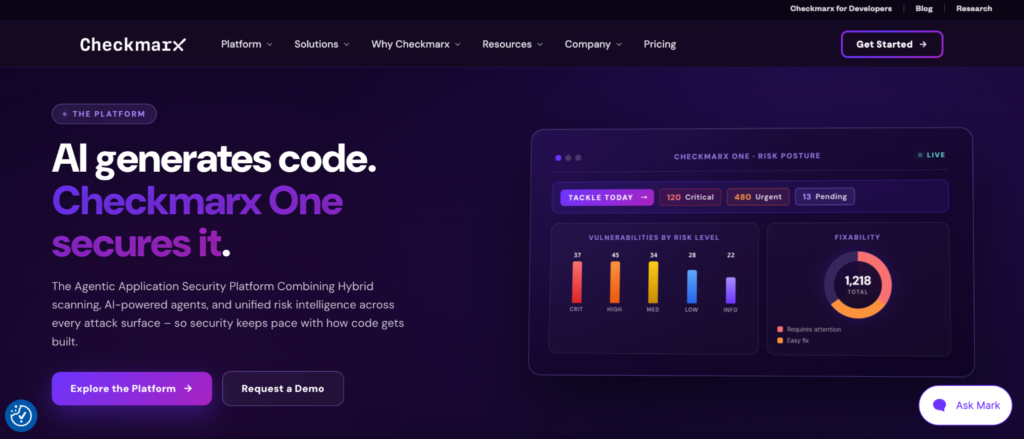
Application security programs often become fragmented as they mature. A new requirement appears. Another tool gets added. Coverage improves, but complexity increases alongside it.
Checkmarx One attempts to provide broader visibility across application security activities through a unified platform rather than a collection of disconnected tools.
Capabilities include:
- SAST
- SCA
- API security
- IaC scanning
- Container security
- Supply chain security
- Application risk visibility
For organizations seeking broader AppSec visibility with fewer moving parts, Checkmarx is frequently considered.
4. Veracode

Enterprise environments present a unique challenge. Security teams may oversee hundreds or thousands of applications, each generating its own stream of findings. Prioritization becomes increasingly important because resources rarely scale at the same pace as security data.
Veracode addresses this challenge through risk visibility, governance capabilities, and application security management designed for larger organizations.
Capabilities include:
- SAST
- DAST
- SCA
- Risk reporting
- Governance support
- Compliance visibility
For mature security programs, context and governance often become just as valuable as detection itself.
5. Semgrep
Many developers distrust security findings for one simple reason. Too many findings fail to feel relevant.
Semgrep has built much of its reputation by providing flexible security testing while allowing engineering teams greater control over how rules are defined and applied. Better signal quality often leads to better developer adoption.
Capabilities include:
- SAST
- Custom security rules
- Secrets detection
- Supply chain security
- CI/CD integration
- Developer workflows
For organizations focused on improving signal quality, Semgrep remains an attractive option.
Security Teams Are Starting To Measure Different Things
Historically, more findings often looked like success. That assumption is changing. Modern security leaders increasingly care about metrics such as:
- Time to remediation
- Developer adoption
- Risk reduction
- Alert quality
- Vulnerability prioritization
A platform that generates fewer but more relevant findings may create significantly more value than one that simply discovers additional issues. This shift is helping reshape the entire AppSec market.
The Goal Is Not Fewer Findings
The goal is fewer distractions. An organization could theoretically eliminate all security noise by hiding alerts. That would solve nothing.
The challenge is helping teams focus on the findings that genuinely affect risk while reducing time spent investigating issues that do not require immediate attention.
The strongest AppSec platforms recognize this distinction. They are designed not merely to detect vulnerabilities but to help teams understand which vulnerabilities matter.
Choosing the Right Platform
The right platform depends largely on where security noise originates. Some organizations struggle with duplicate findings. Others struggle with fragmented visibility across multiple tools. Some need stronger prioritization. Others need better developer workflows and remediation support.
Platforms such as Aikido, ArmorCode, Vulcan Cyber, Checkmarx One, Veracode, and Semgrep all approach the problem differently. What they share is a recognition that security teams do not need more alerts.
They need more clarity. And in modern application security, clarity is often far more valuable than another dashboard full of findings.